
Meet the Author: Sue Cullimore
We speak to Sue Cullimore, the nature-loving author of the Bristol Green Walks book, to find out more about her favourite green spaces to walk around Bristol and some of the surprising wildlife you can spot in the city.
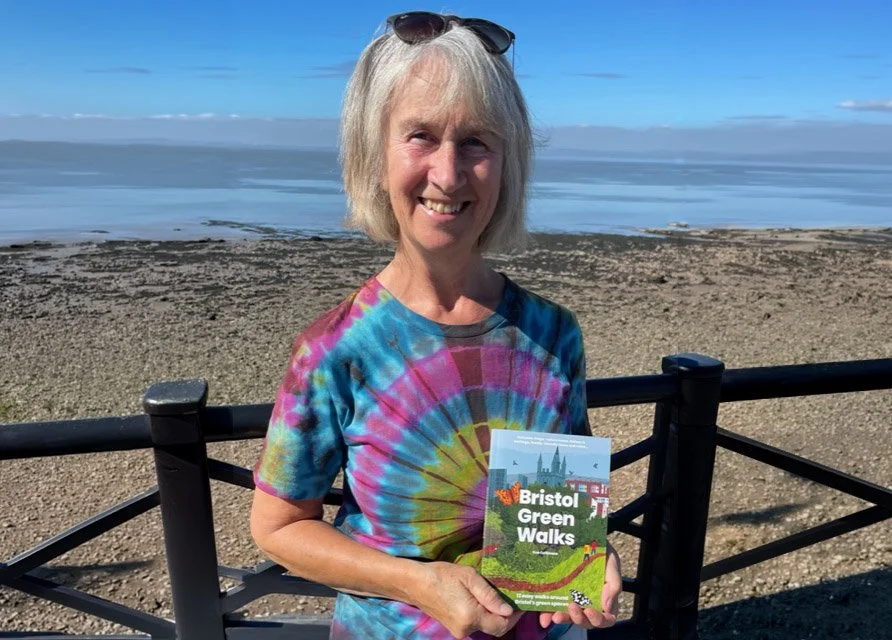
Author, Sue Cullimore
1. What inspired you to write Bristol Green Walks?
During lockdown when we were only allowed to do local walks, Pete, my partner, and I discovered some interesting green areas of the city we’d never visited before, like St Ann’s Valley, Bishop’s Knoll and Trooper’s Hill. We talked, jokingly, about writing a book of ‘Muddy Walks in Bristol’ (all the paths were churned up then!). I have walked many footpaths in the rural areas around Bristol and own a collection of walk books for that.
However, it dawned on me a few years later, when I was looking for a project, that there wasn’t an equivalent book for walks in green spaces in Bristol. So, one day while I was in the shower (I find good ideas often pop up when I’m showering) I decided to write my own, and include some interesting things to see on the way. I much prefer walks with a purpose rather than just walking for its own sake. Maybe it’s my years of leading field trips with students?
2. What were your criteria for choosing which walks and locations to include?
Not all of my original ideas for local walks actually made it into the book in the end, but they are all lovely walks. An important criterion for this book was ease of walking, so that as many people as possible could manage them. I wanted to avoid steeply sloping or very rough paths and those with stiles and too many steps to negotiate.
My idea was to encourage people who aren’t regular walkers, such as people with restricted mobility, families with small children, people who don’t have a car, to go outside into Bristol’s lovely green spaces, and discover some interesting walks. However this book is for everyone, regular walkers or not.
I already knew many interesting and fairly accessible walks, such as St Werburgh’s, Kings Weston, The Downs and Badock’s Wood. However, I realised that I didn’t know many walks in South Bristol for example, and I wanted the 12 selected walks for the book to be spread right across the city. So, I had to get out the map and identify the gaps. In doing so, I discovered some gems.
3. Did any destinations surprise you during your research — perhaps places you hadn’t ever visited before?
Yes, quite a few. For example, Stockwood Open Space was a revelation. It’s an enormous area and has a very natural, wild atmosphere in places, although much of it is actually reclaimed land. There are deer in the woods, rabbits on the edges of the meadows, buzzards wheeling overhead and a patch of ancient oak woodland mentioned in the Domesday Book. I don’t know why it’s not better known, or maybe it’s just that I’d never been there myself and most people already know it?
Lamplighters Walk was also new to me and very interesting for its maritime history and wildlife. It feels very different from any other part of the city and the juxtaposition of wetlands, scrub and trees with the distant views of the docks and industry at Avonmouth and Portbury Docks is very striking.
I’d never been to Manor Woods either, I’m ashamed to say. It’s another brilliant example of a much-loved urban green space with plenty of wildlife and heritage interest for a couple of hours’ walk in the city.
4. Bristol is usually thought of as a large and busy urban area. Would you say it’s a good city for green walks?
Bristol is a great city for green walking. It’s blessed with lots of green space, nearly a quarter of its land area in fact. So, you don’t need to go miles out into the rural areas for an interesting, peaceful walk. There are the big green spaces like Blaise, Ashton Court, Stoke Park, Oldbury Court and The Downs, and there are plenty of well-marked footpaths in these places. Many of these open spaces were formerly owned by rich landowners in the 19th century and earlier, and are now owned and managed by the City Council as recreational and leisure spaces, and for the protection of wildlife.
But there are also many smaller and less well-known patches and strips of beautiful green spaces for walking – for example, alongside Bristol’s rivers, such as the Avon, Malago and Frome; along old railway tracks, like the Whitchurch Way, and in reclaimed industrial areas, for example Trooper’s Hill and parts of Manor Woods.
5. Were there any walks or particular places that became personal favourites while you were researching and writing the book?
I’m very fond of St Werburgh’s - my home patch - which always offers something to make me smile or surprise me, and a bit of peace and green space in which to stop, look and think.
Willsbridge Mill is a place I hadn’t visited for 25 years at least. We used to go there when our son was little, for a run around and messing about in the stream. Revisiting it more recently was wonderful. It’s a fantastic oasis – a secret valley tucked away on the edge of the built-up area of greater Bristol, surrounded by houses yet feeling very rural and magical. I want to go back to it again soon.
6. You’ve included ideas and activities for families and children. What would be your key advice to parents wanting to make a walk more interesting and engaging for younger explorers?
Taking children with you on a walk can be challenging, depending on their ages and interests! I’d talk to them before you set off, about the kinds of things they might see and be interested in - discuss the walk together. Give them some responsibility for planning it if they’re old enough, and let them just enjoy being outside, having a bit of freedom to roam in the open air (safely, of course). Encourage them to use all their senses to find interesting things for themselves, and to be curious about therm.
I’ve included some ideas for families with children in tow in most of the walks in the book. Maybe have a look at these in advance and see if any might appeal to your children. Not all of them will be suitable for all ages and interests but they might give you some tips. For example, there are some questions and quizzes with answers in the back, plus ideas for children’s activities and where to find children’s play areas.
7. What was the most interesting wildlife or natural feature you spotted while doing these walks?
Lots of birds, for example kingfishers in Frome Valley, ring necked parakeets in Oldbury Court, red kite at Stockwood Open Space, peregrines at the Downs and great spotted woodpecker at Purdown woodlands.
Also, some fascinating and unexpected plants, especially in the older woodland of Stockwood Open Space, such as yellow archangel, a key indicator of ancient woodland. The self-generated wildflower meadow at Manor Woods is glorious in early summer. It’s on a slope roughly landscaped in the 1970s over construction waste materials. There are three types of orchids, snakes head fritillary, as well as many species of butterflies.
I always love things geological, so the Avon Gorge and all those rocky limestone cliffs do it for me. I also like the shifting muddy banks of the Avon, especially at Lamplighters, and the railway cutting at Narroways, which slices into red desert mudstones of the Triassic period, formed around 230 million years ago.
8. What did you learn about Bristol’s history and heritage from researching for this book?
The maritime history of Bristol is illustrated brilliantly at Lamplighters. I learnt a lot about the way sailing ships on the Avon were managed by the tough pilot boat captains who guided or towed them around the perilous Horseshoe Bend near Pill. In the same walk I discovered another little bit of maritime history connected to a road name I’d noticed but thought was to do with gallows, Hung Road. It isn’t related to punishing criminals at all, but linked to the way in which the sailing ships were attached to the river banks while waiting for a high tide to allow them to continue their journey up or down river.
All twelve of these walks reveal an interesting local history, and if you look carefully, you will find plenty of evidence of Bristol’s past. From Victorian grist mills on the Frome to the Bronze Age burial at Badock’s Wood and the elegance of 18th century Kingsweston House, every walk has a heritage to discover.
9. Tell us about your other experience in the world of publishing?
I’m the co-author with my late dad Tom Walker, of a novel, ‘Hobthrush’ published in July this year by Sacristy Press in Durham. I found the unfinished manuscript while I was clearing out my family home on Tyneside in 2011, and over the past few years started to work on it and shape it into a fully formed novel. I was absolutely delighted to find a small publisher who would take it on. The novel is about a reluctant anti-nuclear activist who gets tricked into an assassination attempt. It’s set in the mid-1980s when the second Cold War with Soviet Russia was dominating the news and Greenham Common peace protesters were grabbing the headlines. The novel is entirely set on one day in 1987 Northumberland, and has a visionary, dreamlike ending involving St Cuthbert of Lindisfarne (no spoilers!). I’m just sad that dad didn’t live to see it published, but I’m proud that I did it for him.
Otherwise, my writing and publishing experience has been in academia – I’m a retired lecturer in education at Cardiff Uni and UWE. But I did write the ‘Researching the People who lived in your House’ sections of my partner Peter Cullimore’s book ‘Saints, Crooks and Slavers’ which was published by Bristol Books in 2020. This gave me the confidence to send a sample chapter of my green walks book idea to Clive and Joe last November…and the rest is history! I’m glad I did, it’s been a lot of fun.
Bristol Green Walks brings together 12 short walks – each around 2-4 miles – exploring the many green spaces across Bristol. From wooded valleys and wildflower meadows to reclaimed industrial sites now returned to nature, formal parkland and local nature reserves.

12 easy walks around Bristol’s green spaces
Includes:
Maps
Detailed walk instructions
Photos
Nature notes
History & heritage
Family-friendly ideas
And more…
This book brings together 12 short walks – each around 2-4 miles – exploring the many green spaces across Bristol. From wooded valleys and wildflower meadows to reclaimed industrial sites now returned to nature, formal parkland and local nature reserves.
These walks have been selected for relatively easy walking and accessibility, with options for shortcuts, detours and extensions. As well as detailed walk descriptions and route maps, each walk has accompanying information on local history and heritage, nature notes, plus ideas and activities for families and children to help get the most out of your walk. There are also suggestions for public transport links and nearby car parking, plus ideas for refreshment stops along the way.
Bristol is a city with a wealth of green spaces and you don't need to go far to take a walk in nature. Walking in green spaces has many benefits for health and well-being, and it can also be an enjoyable way of discovering new parts of the city and finding out about its history and wildlife. If you want to immerse yourself in Bristol’s green spaces and discover something new along the way, Bristol Green Walks is the ideal first step.